

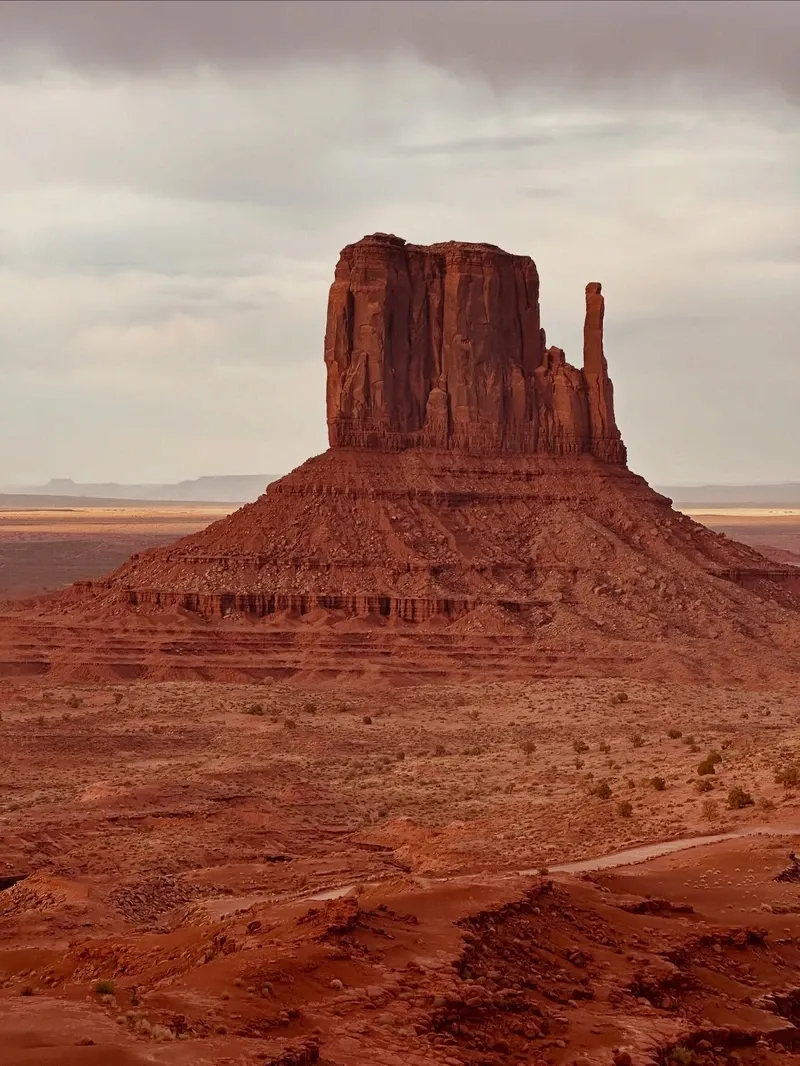
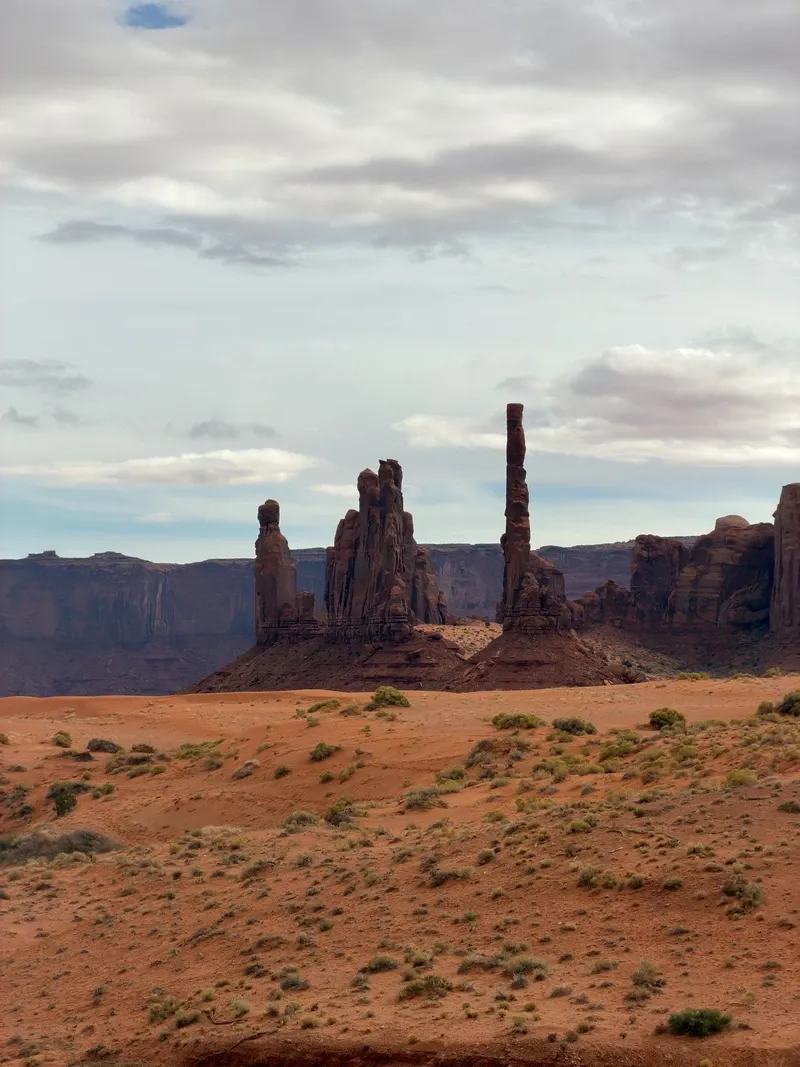
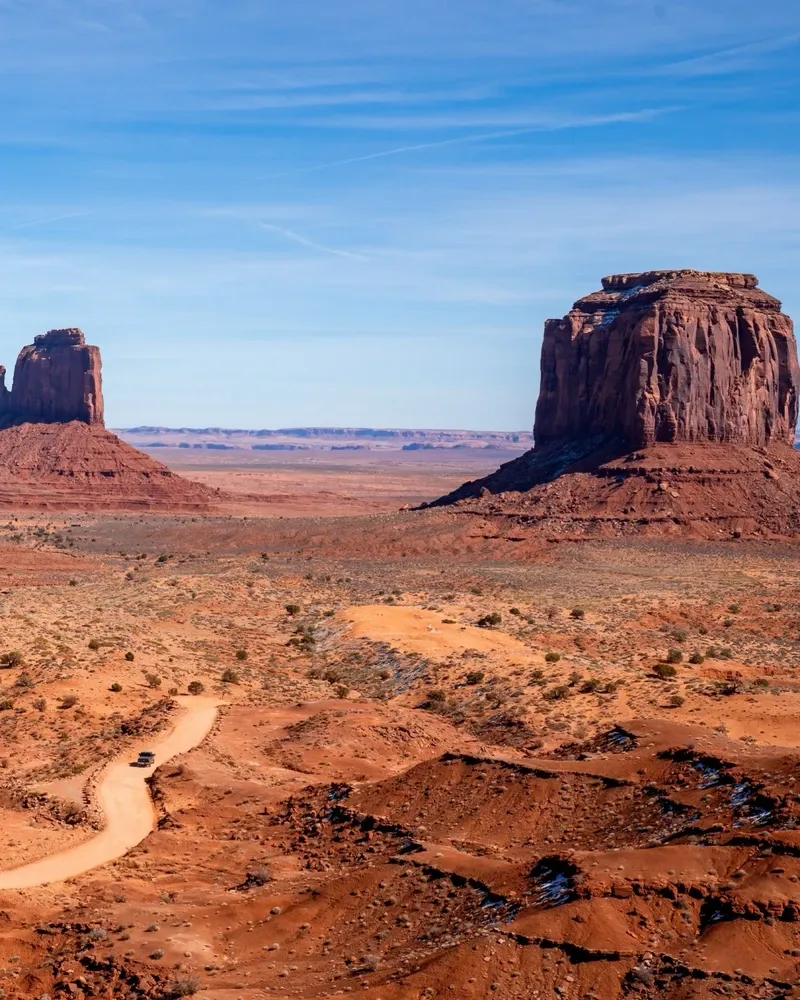
Spanning 91,696 acres, this Navajo Tribal Park protects massive sandstone buttes that tower 1,000 feet above the desert floor. Visitors typically spend three hours driving the 17-mile scenic loop to view the exact geological formations that have defined classic Hollywood films since 1938.
Find Guided ToursLocated on the border of southeastern Utah and northern Arizona, Monument Valley is a 91,696-acre region of the Colorado Plateau. It is defined by massive sandstone buttes, spires, and mesas that rise up to 1,000 feet above a desert floor sitting between 5,000 and 6,000 feet in elevation. Rather than operating as a federal national park, the area is protected as a Navajo Tribal Park. Known as Tsé Biiʼ Ndzisgaii, or "the valley of the rocks," the land is deeply sacred to the Navajo Nation and remains a vital window into their traditional pastoral way of life.
The landscape holds a prominent place in both ancient history and modern cinema. Ice Age Paleo-Indian hunters were the earliest inhabitants, followed around 1200 B.C. by Anasazi farmers who left behind well-preserved petroglyphs. In 1884, President Chester Arthur officially added the region to the Navajo Reservation. Harry Goulding established a trading post in 1924 that helped introduce the area to the outside world. The valley gained global recognition in 1938 when director John Ford filmed the movie "Stagecoach," cementing its status as a legendary symbol of the American West. To protect this heritage, the Navajo Tribal Council established the Monument Valley Tribal Park in 1958.
The prominent sandstone formations are primarily composed of Cutler Group siltstone and reveal three distinct geological layers. Organ Rock shale forms the base, de Chelly sandstone makes up the middle, and Moenkopi shale caps the top.
The striking red coloration visible across the valley is caused by iron oxide exposed in the weathered siltstone. In contrast, the dark blue-gray streaks running down the cliff faces are the result of manganese oxide. Together, these elements create the stark, highly recognizable profiles that define the horizon.

Discover the full history and cultural significance on our About page.
Walk directly into the shadow of West Mitten Butte on this 3.2-mile self-guided loop. As the only path in the 91,696-acre park allowing independent hiking, it provides close-up views of the 1,000-foot sandstone structures. The trail totals four miles from the parking lot and guarantees deep desert solitude.
Drive to the far end of the 17-mile unpaved loop road before dawn. As the sun rises in the east, it casts a warm, golden glow across the western faces of the towering buttes. This viewpoint provides ideal lighting for capturing the vast, 5,000-foot elevation desert floor.
Stand exactly where directors framed classic Hollywood films since the 1930s. Named after the famous filmmaker, this spectacular viewpoint features steep drop-offs and sweeping views of the Cutler Group siltstone formations. Visitors can capture their own versions of the iconic 'Man on a Horse' photograph against the towering mesas.
Plan a visit around late March or mid-September to witness a rare astronomical spectacle. Peaking near March 30th and September 13th, the setting sun aligns perfectly to cast the massive silhouette of West Mitten Butte directly onto East Mitten Butte. The viewing terrace offers the best vantage point.
Hand-picked tours with free cancellation and verified reviews
 Free Cancellation 3h
  Free Cancellation 2h 30min
  Free Cancellation 3h
  Free Cancellation 3h
  Free Cancellation 3h 30min
  Free Cancellation 2h 30min
  Free Cancellation 3h
  Free Cancellation 2h
 The ideal times to visit Monument Valley are the shoulder seasons of early spring and late fall, which provide comfortable daytime temperatures and minimal crowds. Late March and mid-September are especially notable for the unique Mitten Shadow event at sunset.
Early spring provides comfortable daytime temperatures and small crowds, though mornings are chilly. Late March features the unique Mitten Shadow event, perfectly aligning shadows across the buttes at sunset.
Intense heat frequently exceeds 100°F, accompanied by extremely long wait times and high traveler volumes. The monsoon season begins in July, bringing severe afternoon thunderstorms and dangerous flash flood hazards.
Early autumn still carries monsoon risks, but mid-September delivers the spectacular Mitten Shadow event. Late fall transitions into a highly recommended shoulder season with comfortable temperatures and very small crowds.
Nighttime temperatures regularly drop below freezing, requiring heavy insulated layers for morning tours. Traveler volumes are low, but daylight is limited with the scenic drive closing at 5:00 pm.
The Scenic Drive operates daily with seasonal variations. Summer hours are 8:00 am to 7:00 pm, with the last entry permitted at 4:30 pm. Winter hours are 8:00 am to 5:00 pm, with the last entry at 2:30 pm. The park is closed on Thanksgiving Day, Christmas Day, and New Year's Day.
| Category | Price |
|---|---|
| General Admission (per person, per day) | $15 |
| Scenic Drive Access (per vehicle) | $20 |
Because Monument Valley is a Navajo Tribal Park rather than a federal facility, America the Beautiful and Golden Eagle National Park passes are not accepted.
For complete schedules and ticket prices, visit our Hours & Fees page.
Monument Valley is accessible primarily by driving along Highway 163, which connects southeastern Utah and northern Arizona. Visitors typically travel by car from nearby regional hubs like Page, Moab, or Cortez.
📍 Border of southeastern Utah and northern Arizona
Traveling from Page requires driving east along Highway 160 directly across the Navajo Reservation. Upon reaching the town of Kayenta, motorists must turn north onto Highway 163 to access the valley entrance. This highly scenic route covers a total distance of 195 kilometers. Under normal driving conditions, the trip takes approximately two hours to complete.
Drivers leaving Moab will follow Highway 191 south through the towns of Monticello and Blanding until reaching Bluff. From Bluff, vehicles take Highway 163 south directly into Monument Valley. This specific 238-kilometer route passes the famous Forrest Gump Point along the way. Expect the drive to take just over two and a half hours.
Motorists departing from Cortez need to drive west toward the Utah border. The route then connects with Highway 163, heading south straight into the tribal park. Covering 224 kilometers, this drive provides beautiful views of the surrounding red rock country. The entire transit takes roughly two hours and sixteen minutes under standard conditions.
For detailed transport options and routes, visit our Directions page.
Independent off-road travel in the backcountry is strictly prohibited. To access restricted areas across the 91,696-acre park like Mystery Valley or Hunts Mesa, you must hire a licensed Navajo guide. These tours fill up quickly during the peak summer season. Reserve your spot well in advance to guarantee access.
The 17-mile scenic loop drive consists entirely of unpaved dirt, gravel, and deep sand dunes. While a standard sedan can make the drive in dry weather, high-clearance SUVs are strongly recommended to avoid vehicle damage. RVs, camper vans, and motorcycles are strictly prohibited on this route.
Summer temperatures regularly exceed 100°F across the entirely unshaded valley floor. Carry at least one gallon of water per person to prevent severe dehydration. This is especially critical if you plan to hike the 3.2-mile Wildcat Trail. Limit your strenuous activity during the peak afternoon heat.
Private Navajo families still live within the valley floor and herd sheep near the 17-mile loop road. Always stay on designated public routes to avoid trespassing on residential property. Never photograph residents without their explicit permission. Leave your drone at home, as they are strictly prohibited and will be confiscated.
The monsoon season from July through September brings violent afternoon thunderstorms and rapid flash flooding. These sudden storms can turn the unpaved loop road into a treacherous mud hazard. Always check with the Visitor Center for real-time road conditions before driving. Never attempt to cross flooded dry washes.
Monument Valley is a sovereign Navajo Tribal Park rather than a federal national park. America the Beautiful National Park passes are not accepted here. Visitors must pay a $15 per person daily entry fee at the gate. An additional $20 vehicle fee is required to access the Scenic Drive.
Often described as a miniature Monument Valley, this area features a 17-mile scenic dirt road winding through similar sandstone formations. The Bureau of Land Management oversees the site. It provides a peaceful, uncrowded alternative for visitors.
This state park provides a stark aerial view of the San Juan River making a series of dramatic loops. The river carves heavily through the landscape. It travels seven miles of twists while advancing less than two miles.
This Navajo-managed landmark is the only location in the United States where four states intersect. Visitors can stand simultaneously in Arizona, Utah, Colorado, and New Mexico. Local vendor booths also sell handmade jewelry and crafts nearby.
Read what travelers share about their experience visiting Monument Valley — from practical tips to personal highlights.


No, America the Beautiful National Park passes are not accepted because Monument Valley is a Navajo Tribal Park. The general admission fee is $15 per person per day, plus an additional $20 vehicle fee to access the 17-mile Scenic Drive.
During the summer, the Scenic Drive is open Monday through Sunday from 8:00 am to 7:00 pm, with the last entry at 4:30 pm. Winter hours run from 8:00 am to 5:00 pm daily, requiring visitors to enter by 2:30 pm.
The drive from Page takes approximately two hours under normal conditions. The 195-kilometer route follows Highway 160 east across the Navajo Reservation before turning north onto Highway 163 at Kayenta.
Visitors should wear tennis shoes, a hat, and layered clothing like a t-shirt with long sleeves to handle drastic high desert temperature changes. Because summer temperatures frequently exceed 100°F, you must carry at least one gallon of water per person to prevent severe dehydration.
The main Visitor Center terrace is fully wheelchair accessible and provides spectacular viewing platforms of the Mittens and Merrick Butte. However, the 17-mile scenic loop drive is a rough, unpaved dirt road with deep sand dunes that cannot accommodate independent wheelchair travel.
You can drive the 17-mile scenic loop or hike the 3.2-mile Wildcat Trail without a guide. Accessing restricted backcountry areas like Mystery Valley or Hunts Mesa requires booking a guided tour with a licensed Navajo operator.
Late March and mid-September are highly recommended because they feature comfortable temperatures, small crowds, and the spectacular Mitten Shadow event. The peak summer season from May to September brings intense heat exceeding 100°F, severe afternoon thunderstorms, and long wait times.
A standard sedan can complete the drive in dry weather if driven slowly and with extreme caution. High-clearance vehicles or SUVs are strongly recommended because the unpaved dirt road contains rough terrain, severe potholes, and deep sand dunes.
Browse verified tours with free cancellation and instant confirmation.
Find Tours